
Understanding Genesee County Releases
A person can leave Genesee County Jail for several very different reasons. Bond, personal recognizance, dismissal, time served, sentence completion, and a court program can return someone to the community. An exit may instead be a transfer to the Michigan Department of Corrections, another county, federal custody, a hospital, or immigration custody. The word “released” should match the recorded disposition. A transfer ends the local booking, but it does not end confinement.
The Office of Genesee County Sheriff keeps the local custody event. The court holds the order that explains why release or transfer was allowed. MDOC records state prison, parole, felony probation, and recent discharge. Michigan VINE sends participating-agency notices. Federal and immigration systems cover their own custody. No one source is a universal list of Genesee County released inmates, so the last known custodian is the best starting point.
- Time served
- The court credits enough time in jail to satisfy the imposed jail term.
- Parole
- A state prisoner leaves prison under MDOC control before the maximum sentence ends.
- Probation
- A court orders community supervision, which may follow jail but does not prove a prison release.
- Discharge
- The relevant term of correctional supervision has ended.
Genesee County Release Types
The release code or destination controls where the next reliable record will appear. A bond order may authorize community release while the criminal case remains open. A sentence to MDOC produces a local transfer followed by state intake. Tether and work release can place a person outside a cell while county control continues. That distinction matters because physical absence is not always unconditional freedom.
| Exit type | What it means | Best next source |
|---|---|---|
| Bond or recognizance | The court permits community release subject to the order. | District or circuit docket plus the Sheriff release transaction |
| Dismissal or time served | A case or jail term no longer supports that booking. | Signed court order and local release record |
| Probation, tether, or work release | The person may remain under court or county control outside a cell. | Operative court order and supervising unit |
| MDOC commitment | Local custody ends through transfer to the state prison system. | OTIS after state reception processing |
| Other-custodian transfer | Another county, federal agency, or immigration authority receives the person. | The identified receiving agency |
Leaving a Genesee County cell does not prove the person returned to the community. Confirm the exit code and destination.
Genesee County Release Record Fields
A local release record may be a jail-management release screen, a jail-register entry, a closed booking sheet, a property receipt, or a row in an agency export. Genesee County does not publish an official field schema online. A focused request should therefore name the documents and the facts sought without claiming that every field exists. The most useful record ties the physical exit to one booking episode.
| Requested field | What it can establish |
|---|---|
| Booked name and aliases | The identity used for that admission |
| Booking number | The unique local custody episode |
| Admission date and time | When the booking began |
| Charges and holding authority | Why the Sheriff held the person |
| Court and case number | The docket connected to the custody event |
| Bond type or amount | The release authority when bond applied |
| Release date and time | The recorded physical out event |
| Release code or destination | Whether the exit was community release, transfer, or another disposition |
| Booking photograph | The image linked to that booking, if retained and disclosable |
Not every item is public, retained, or filled in. A verbal status answer can help quickly, but it is not the same as a durable record. When the exact time or destination matters, ask for the release transaction or jail-register entry. When the legal reason matters, obtain the signed court order as well.
Request Genesee County Release Records
Genesee County accepts public-record requests through its Freedom of Information page and the linked NextRequest portal. A narrow description improves the chance that staff can locate and price the correct record. Include a complete requester name, a valid mailing address, and a working telephone number or email, as the County requires.
- Identify the person with a full booked name, date of birth, booking number if known, and an approximate booking range.
- Ask for the booking sheet, jail-register entry, and release transaction. Name the release date, time, disposition, authority, and transfer destination as requested fields.
- Request the associated booking photograph only if it is needed and identify the exact booking.
- Choose electronic delivery when practical. Ask for an estimate before work if cost is a concern.
- If no record remains, ask the County to identify the applicable retention schedule. If part is denied, review the cited exemption and appeal instructions.
Board of Commissioners
324 South Saginaw Street
Flint, MI 48502
810-257-3014
Michigan FOIA permits charges for allowed labor, copies, media, and mailing. The research found no fixed Genesee release-record price, so a flat fee should not be assumed. The county office may hold a jail record, while courts use their own judicial record-access procedures. State prison and parole records belong with MDOC FOIA.
Genesee Release Records Under FOIA
Michigan’s Freedom of Information Act, MCL 15.231 through 15.246, governs executive-branch public records. A request must describe the record well enough to find it. MCL 15.235 provides an ordinary five-business-day response period and permits one written extension of up to ten more business days. The response may grant the request, deny it with reasons and appeal rights, or grant it in part. That deadline concerns the agency’s response, not a promise that every record will be delivered at once.
FOIA does not make each record free, permanent, unredacted, or available online. Privacy and law-enforcement exemptions can apply. Juvenile material is restricted. A set-aside can change ordinary access to a conviction record, but it is not a new release date and does not guarantee that every independently kept image disappears. Ask for a written legal basis when material is withheld.
Record rule: online absence and record destruction are different. GCSO has no public historical roster, and the official sources state no local online retention window.
Genesee Releases and Clean Slate
Michigan’s Clean Slate changes affect later access to eligible conviction information, not the earlier physical release itself. Automatic processing began in 2023. The Michigan State Police summary explains that an eligible felony can face a ten-year clock measured from sentence or completion of MDOC imprisonment, whichever occurs later. Eligibility limits, exclusions, and intervening events still control.
An application-based set-aside is filed in the court of conviction. Separate courts may require separate filings. A release transaction, court order, OTIS profile, and booking image can also have different owners and access rules. No one should treat set-aside as proof that the person left jail on the set-aside date. For help with record-relief questions, Legal Services of Eastern Michigan provides civil legal intake for Genesee County, but representation is not guaranteed.
Find Genesee County Released Inmates
The strongest search follows custody, legal authority, and destination in that order. Start locally when the last known place was Genesee County Jail or Flint City Lockup. GCSO does not publish a current roster or historical release feed. Its inmate-information line can address whether a person remains booked and may clarify whether the exit was release or transfer. A written release transaction is stronger when proof matters.
- Call GCSO at 810-257-3426 with the full name, date of birth, and approximate booking date.
- Check 67th District Court for bond, misdemeanor, and preliminary felony events, or Seventh Circuit for felony judgment and sentence.
- If the court imposed an MDOC sentence, allow for state intake and search OTIS by MDOC number or carefully matched identity.
- Use Michigan VINE for a participating agency and prospective custody-change alerts.
- Branch to BOP or ICE only when facts support federal or immigration custody.
- Request the local release transaction and controlling court order when online sources do not settle the question.
A person normally drops from a live roster after an exit, but disappearance alone never identifies the reason or destination.
For a same-day event, the Genesee County jail releases page explains the official fallback because no Sheriff feed exists. Match people with stable identifiers. Shared names, similar ages, or the same county are not enough when other details conflict.
Genesee Release Orders Across Courts
Genesee release verification often crosses two court systems. The 67th District Court search covers arraignment, bond, misdemeanors, and preliminary felony events. The Seventh Judicial Circuit search carries felony proceedings after bind-over, including judgment, jail credit, probation, and later orders.
A docket is an index. A bond entry proves that release was authorized under stated terms, but it may precede jail processing. Dismissal in one case may coexist with a hold in another. A prison commitment supports transfer to MDOC, not community release. Pair the signed court instrument with the Sheriff’s physical out transaction for the clearest account.
The manifest capture of the official district-court interface shows where the local court search begins.
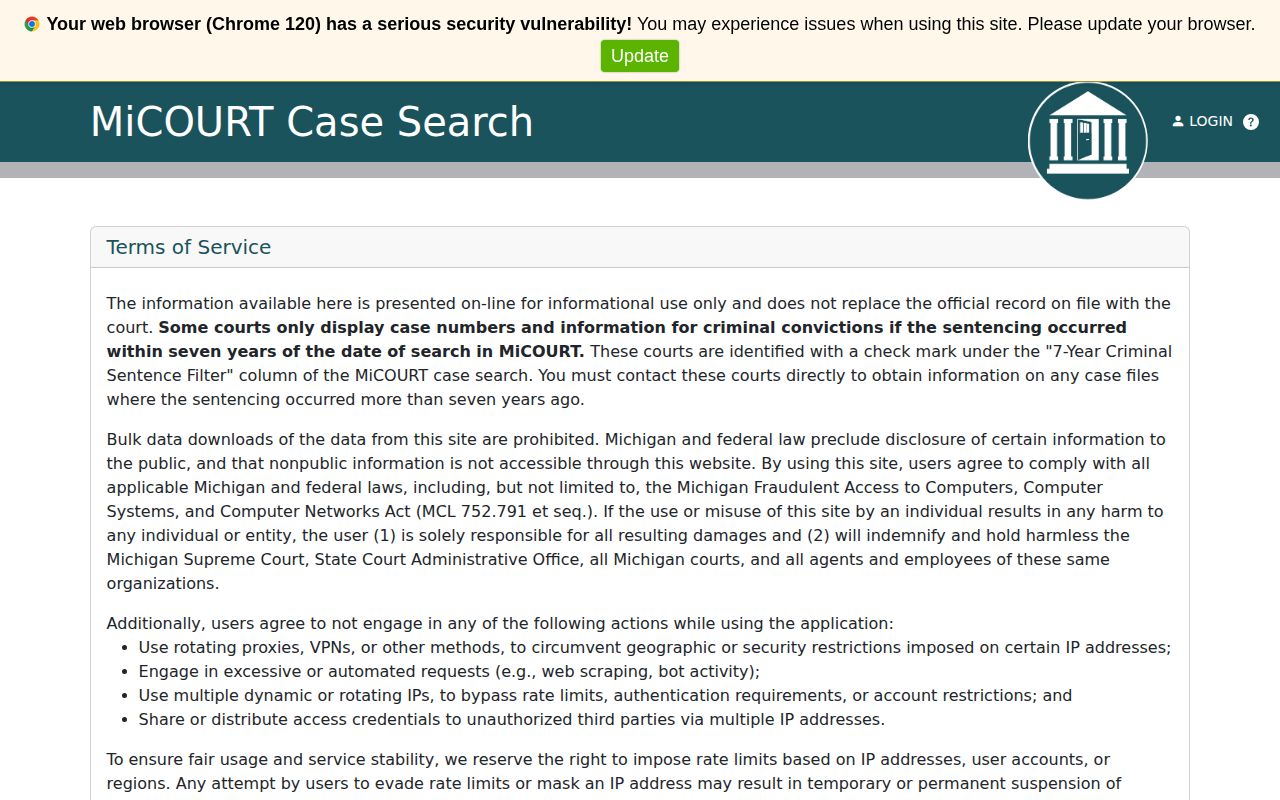
The court result explains legal events, while the jail record remains the source for the actual release-processing time.
MDOC Genesee Release Search
The MDOC Offender Tracking Information System, or OTIS, covers current prisoners, parolees, probationers under MDOC supervision, and people discharged within three years. It excludes county-jail-only and city-lockup-only people. That scope warning is critical in Genesee County because the Sheriff’s resource route points to OTIS even though many local detainees never enter MDOC jurisdiction.
| OTIS field | Use | Release meaning |
|---|---|---|
| MDOC number | Most precise six-digit identifier | Links the person to the state record |
| Name | Broad search when the number is unknown | Must be checked against other identifiers |
| Offender status | Filter for prisoner, parolee, probationer, discharged, or absconder categories | Distinguishes prison, community supervision, and recent discharge |
| Current status and location | Shows custody or supervising office | Parolee means outside prison but still under MDOC control |
| Earliest Release Date | First Parole Board jurisdiction date | Eligibility, not a promised release |
| Maximum Discharge Date | Outside sentence endpoint if parole does not occur sooner | Not a county-jail release time |
The official OTIS information page explains the three-year post-discharge display limit and the exclusion of jail-only people.
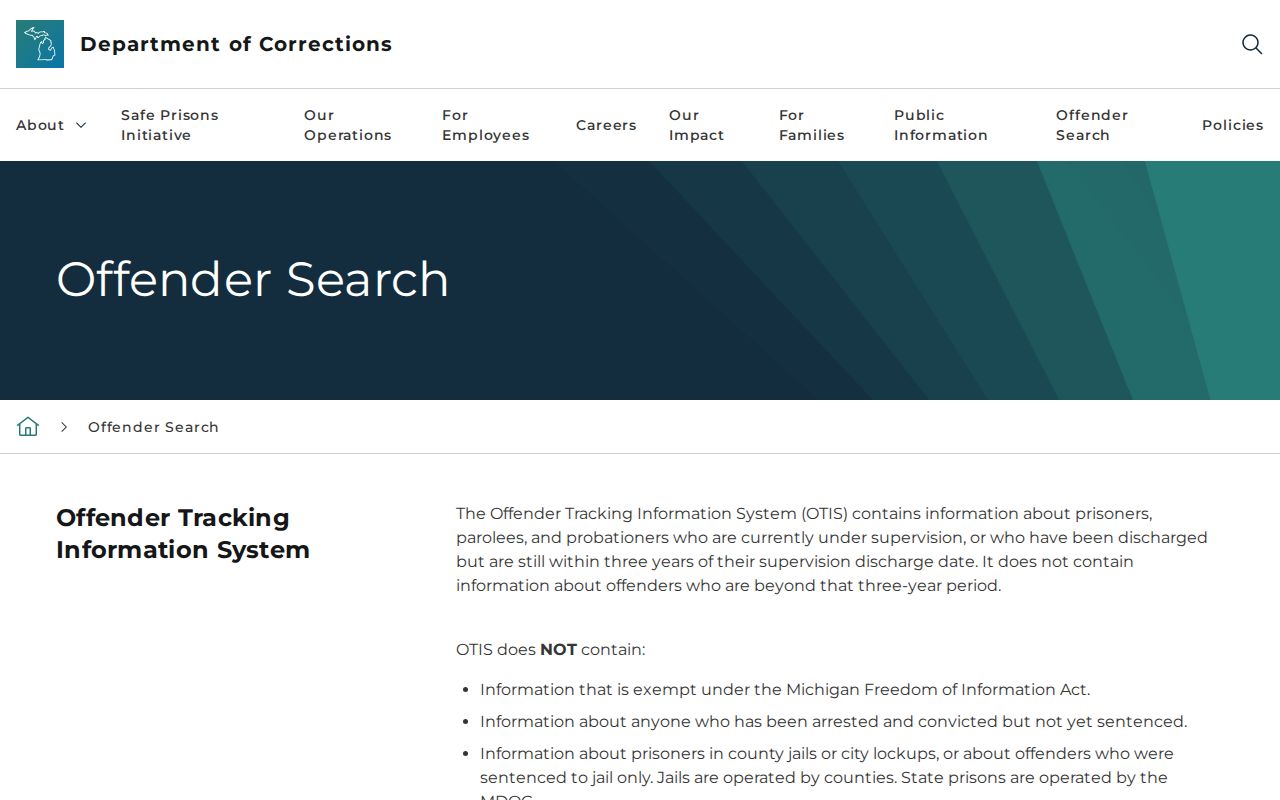
An older discharge may no longer appear online even though court and MDOC records still exist. Use the sentencing court and a narrow MDOC FOIA request for older proof.
Genesee County Recent Release Limits
No official GCSO 24-hour, 48-hour, or 72-hour release view was found as of the research date. The Sheriff’s Corrections Division page offers no booking-card search, release tab, historical archive, stated update cycle, or online booking-photo feed. Commercial roster pages do not turn into official sources merely because they use local terms.
The GCSO Corrections Division page documents the facilities, local information line, and Michigan VINE route.
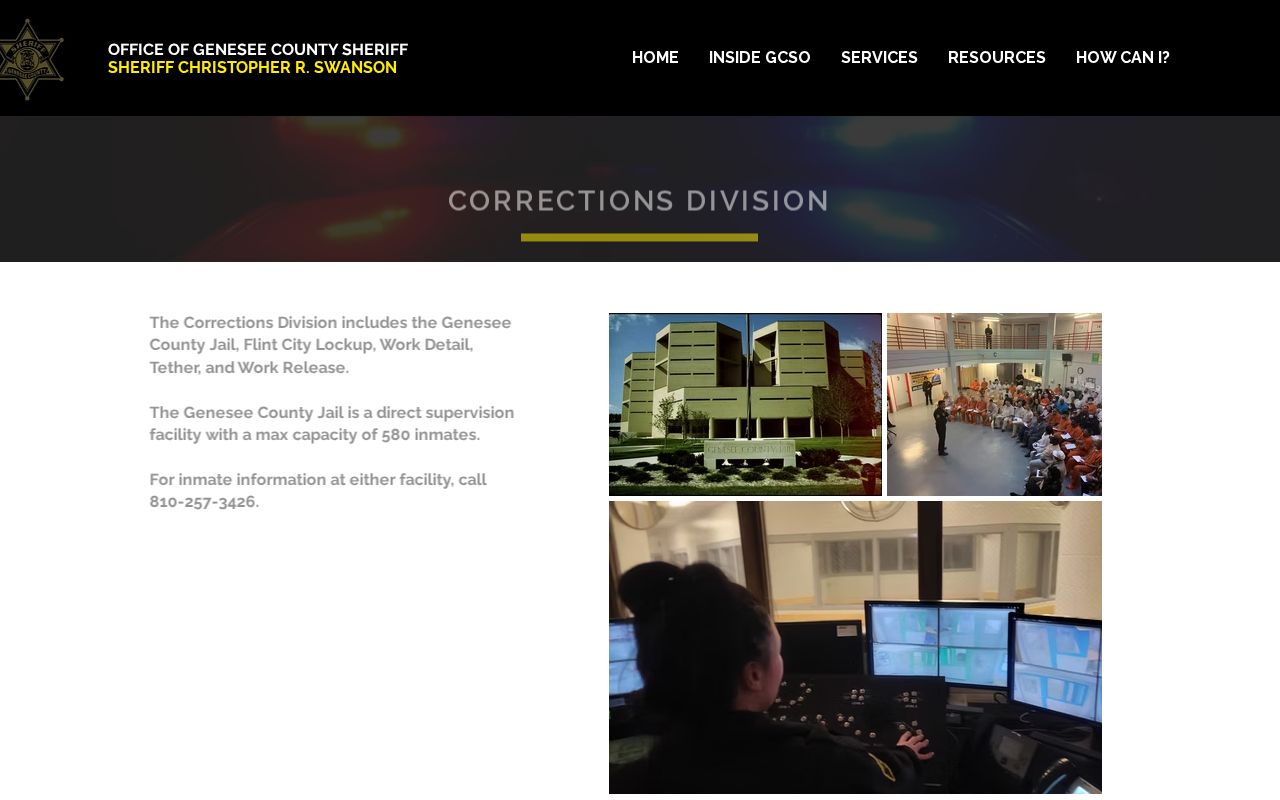
The screenshot also shows why the accurate local path relies on phone, court, VINE, and FOIA instead of a claimed recent-release button.
Ask two separate questions: whether the person is still booked, and whether any recorded exit was community release or transfer. A new court order may also take time to appear in a public index. No official Genesee rule guarantees a release hour, a weekend substitute date, or a three-day web retention period.
IGNITE After Genesee County Custody
Genesee County Jail began the IGNITE educational initiative in September 2020. That history creates local context for education and reentry, but participation is not a release code and does not confirm that anyone has left custody. The published evaluation and later local reporting describe the program’s Genesee origins.
Release verification still rests on the Sheriff record, court order, or receiving corrections system. A program record may add context to a jail stay. It cannot replace the physical release transaction. When civil legal navigation is needed after release, Legal Services of Eastern Michigan serves Genesee County through its Flint office.
Genesee Release Supervision Status
Parole and probation are distinct. A parolee has left state prison but remains in MDOC legal custody until discharge under MCL 791.238. Felony probation is court-ordered community supervision and may exist without a state prison term. OTIS can show both categories, the assigned supervision location, and a recently discharged status.
Genesee sits in MDOC Region 6. The official directory lists Region 6 Operations, Genesee Parole, and Genesee Probation at the same Flint address with separate telephone numbers. Use the office shown on the matched OTIS profile. An “absconder” label is a supervision status, not proof of a new conviction or local booking. The Genesee probation and parole page gives the full verification route and local contacts.
Genesee Release Alerts and Federal Records
Michigan VINE is a free custody-information and notification service. GCSO links it as the local alert route. Search the correct person and agency, then register for release, transfer, or other offered status changes. A VINE notice is useful for timing, but the source agency and court remain the record owners. A negative result can reflect spelling, timing, transfer, or agency coverage rather than a proven release.
Federal imprisonment uses a different system. The BOP Inmate Locator covers federal prisoners from 1982 forward and may show a former prisoner’s release date. “Released” or “Not in BOP Custody” speaks only to BOP custody. It does not rule out state, local, immigration, parole, or supervised-release control. The U.S. Marshals Service manages much federal pretrial detention and transport but has no comparable historic public release list.
ICE After Genesee County Release
A person can leave Genesee criminal custody and enter civil immigration custody. The ICE Online Detainee Locator System checks current detention and a limited period after ICE release. It accepts an A-number with country of birth or exact identity details. A no-result is inconclusive because timing, name matching, age limits, restricted data, transfer, or lack of ICE custody may explain it.
No Genesee County ICE detention contract was verified. ICE should be checked only when the facts support that branch, not as a routine substitute for an unavailable local answer. A county disappearance does not prove community return, and an ICE result does not provide a county release certificate.
Older Genesee County Release Records
The present Genesee County Jail succeeded an older facility when inmates moved in November 1988. The official courthouse history helps identify which facility may have created an old record. It does not establish today’s retention period and should not be used to promise that a decades-old release transaction survives.
For older local events, identify the approximate booking, court, and date range before contacting the County. For an old MDOC discharge, use the sentencing court and MDOC FOIA after OTIS’s public three-year window closes. The source and age of the event determine the search route.
Compare Genesee Release Sources
Each system answers a narrower question. Using the source that owns the event prevents a local transfer from being mislabeled as freedom and prevents a state discharge from being treated as proof of an unrelated jail release.
| Source | Best answer | Key limit |
|---|---|---|
| GCSO information and release record | Local booking presence, exit time, and recorded destination | No public online roster or release archive |
| District or circuit court | Bond, dismissal, sentence, probation, or commitment authority | Order time may differ from jail processing |
| OTIS | State prisoner, parolee, probationer, or recent discharge | Excludes jail-only cases and older discharges |
| Michigan VINE | Participating-agency custody notice | Notification is not a certified court or release record |
| BOP locator | Federal prison status or former-prisoner release date | Does not cover county, state, USMS, or ICE custody |
| ICE ODLS | Current or limited recent ICE location data | No-result does not prove release |
Why Flint Has No Roster
Flint City Lockup is not presented as a separate public jail website. The Sheriff lists it within the Corrections Division and directs questions about either local facility to the same inmate-information number. A city agreement describes the holding function as Sheriff-operated pre-arraignment space in the county-jail setting. That arrangement explains why searching for a separate Flint release roster leads nowhere.
A person may leave the lockup after short-term processing, move to court, enter the regular county jail, or be released under lawful authority. OTIS does not record the lockup episode unless a related case later places the person under MDOC jurisdiction. The shared GCSO line and the relevant court docket are the first sources.
Genesee County Release Facilities
The Corrections Division groups five local custody or correctional components. Only the main jail has a published separate street address and capacity in the reviewed material. The other components use the shared Sheriff inquiry route, and their legal effect must be read from the related court or program record.
- Genesee County Jail is the main county detention facility; an exit may be community release or transfer.
- Flint City Lockup is short-term, Sheriff-operated pre-arraignment custody rather than an MDOC prison.
- Genesee County Work Release may end in community release, return to jail, or another court-directed result.
- Genesee County Tether can continue court or county control outside a cell.
- Genesee County Work Detail participation alone does not prove discharge.
No operating state prison, federal prison, or ICE detention center was identified inside Genesee County. A state or federal sentence can still move a person to a facility elsewhere, where the receiving agency becomes the correct source.