
Genesee Projected and Actual Release
Michigan’s public records do not provide one universal projected date. For an MDOC prisoner, OTIS uses two key labels: Earliest Release Date and Maximum Discharge Date. The earliest date marks the point when the judicial minimum has been served and the Parole Board gains jurisdiction. It is an eligibility boundary. The maximum date is the outside sentence endpoint if parole does not occur first, subject to lawful changes in the sentence computation.
An actual release happens only after the responsible agency completes the release or transfer. A parole grant, court order, or calculated date can precede that event. A Genesee County Jail detainee awaiting trial usually lacks a fixed release date because a bond decision, dismissal, plea, sentencing event, or another hold can alter the path. A sentenced county jail inmate may have a calculated out date, but that calculation belongs to the jail and the judgment, not OTIS.
A bond order is legal authority for release, but it does not prove that jail staff completed the physical process at the same moment. Another Genesee case, an out-county warrant, a federal matter, or an immigration detainer can keep the person confined or produce a transfer. Read every known case and ask GCSO whether the recorded disposition was community release or transfer. That answer is more precise than adding time to a docket entry.
Find a Genesee Release Date
Start with the last known custodian. The Genesee County Sheriff and local courts handle county jail episodes. MDOC handles a state prison sentence and later parole. Mixing those systems produces false negatives. The OTIS offender search expressly excludes people whose sentence was only in a county jail or city lockup.
- Identify whether the person is at Genesee County Jail, Flint City Lockup, an MDOC prison, or already on community supervision.
- For county custody, call GCSO inmate information at 810-257-3426. Ask whether the person remains booked and whether staff can state a scheduled or recorded out date.
- Open the correct 67th District or Seventh Circuit case. Read the judgment, jail credit, bond orders, later amendments, and any commitment to MDOC.
- For an MDOC sentence, search OTIS by the six-digit MDOC number when known. Match the profile before reading any date.
- Review every sentence row, Current Status, Earliest Release Date, and Maximum Discharge Date. Multiple or consecutive terms can change the timeline.
- Confirm the completed event later through the responsible agency, OTIS status, or a custody notification. Request the underlying record when a durable date is needed.
The full county-jail confirmation route is also explained in the Genesee County released-inmate lookup. For a date question, the essential step is to keep the court’s legal authority separate from the custodian’s physical out transaction.
Genesee MDOC Release Date Fields
OTIS covers current prisoners, parolees, probationers, and people discharged within three years of the end of MDOC supervision. A profile can show the MDOC number, Current Status, prison or supervision location, offense and sentence rows, sentencing county, and an image when available. The state page should be treated as a linked set of fields, not a single-date calculator.
| OTIS field | What it establishes | What it does not establish |
|---|---|---|
| Current Status | Prisoner, parolee, probationer, discharged, or another displayed MDOC category | The exact Genesee County Jail exit time |
| Earliest Release Date | First Parole Board jurisdiction date based on the minimum term | A guaranteed physical release date |
| Maximum Discharge Date | Outside maximum-term endpoint if parole does not occur earlier | A promise that no lawful recalculation will occur |
| Sentence rows | Offense, county, term, and related date context | A complete county jail booking history |
| Supervision location | The assigned office after release to parole or probation | A home address |
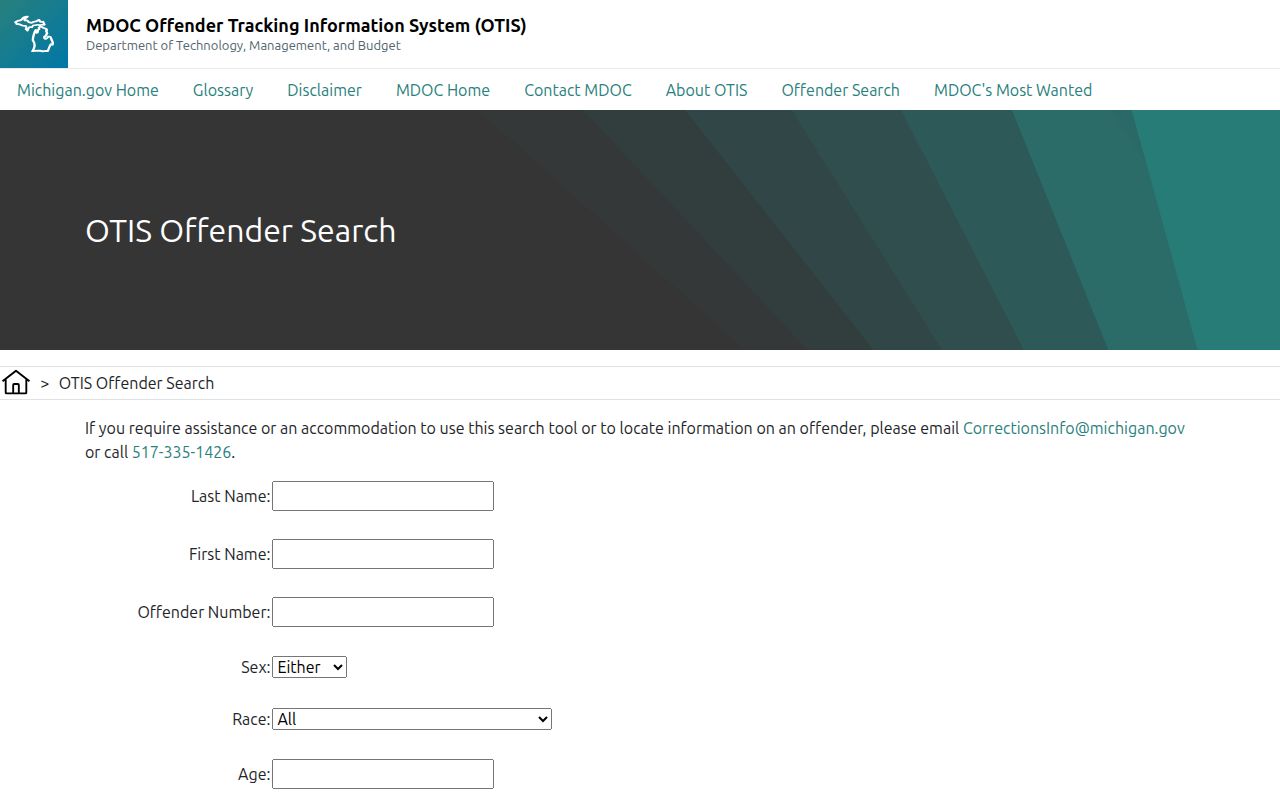
The official MDOC search screen below shows the state route used for an MDOC number or carefully matched name search.
For an older state discharge no longer displayed, identify the sentencing court case and submit a focused MDOC public-record request. Name the discharge certificate, sentence-computation record, or other document actually needed. OTIS removal after three years is a public display limit, not proof that all state records disappeared.
Genesee Release Dates and Truth
Michigan truth in sentencing is not a generic rule that every prisoner serves 85 percent. For covered cases, the person must serve the full judicial minimum before parole consideration. MDOC states that good time or disciplinary credits do not reduce that minimum for covered offenses. The scheme applies to specified assaultive crimes committed on or after December 15, 1998 and other crimes committed on or after December 15, 2000. The offense date and judgment therefore matter.
MCL 800.34 addresses the truth-in-sentencing framework, while MCL 800.33 and MCL 800.35 are relevant to legacy credit rules. Older crimes may fall under a different credit system. No sound estimate can be made from sentence length alone without the offense date, minimum term, sentence structure, and credit rules that actually apply.
For a covered case, Class I misconduct produces disciplinary time that the Parole Board must consider. It should not be presented as a simple automatic number added to a date. Reaching the minimum opens Board jurisdiction; it does not compel release.
The sentence table also matters when more than one conviction is involved. Concurrent terms may overlap, while consecutive terms run in sequence under the judgment. Resentencing, corrected credit, and an appeal can change the inputs MDOC received from the court. When a believed date error traces to court data, obtain the latest signed order and ask the sentencing court to address it. MDOC states that it corrects OTIS when directed by the court or supervising agent.
Note: Michigan’s official date labels and the person’s judgment are safer than an online percentage formula with no offense-date analysis.
Genesee Jail Release Calculations
A county jail sentence runs on a separate track from an indeterminate MDOC prison term. Michigan provisions such as MCL 51.282 and MCL 801.257 address possible county jail reductions or good time. They do not create a public Genesee calculator. The actual result depends on the sentence, jail credit, eligibility, conduct, and lawful jail administration.
Obtain the signed judgment first. It supplies the jail term and credit ordered by the court. Then ask GCSO for the scheduled out date recorded for that booking. If the figures conflict, verify the judgment with the clerk and the calculation with the jail. A court register may show when an order was entered, yet it may not show when release processing finished.
No official Genesee weekend-release rule, fixed release hour, or public calculator was found in the official-source sweep. A weekend or holiday may separate the order date, administrative work, and later docket update, but no local timing promise should be inferred from that possibility.
Why Genesee Release Dates Change
A projected date is a calculation inside an active legal process. Corrected jail credit, another sentence, a court amendment, Board action, or a hold from another authority can change what occurs. Multiple sentence rows should always be read together. A date taken from one row may not describe the controlling term.
| Factor | Possible effect | Best confirmation |
|---|---|---|
| Corrected judgment or jail credit | Changes the time calculation | Signed court order and updated agency computation |
| Consecutive or overlapping sentences | Moves the controlling earliest or maximum point | All sentence rows and the judgment |
| Legacy credits or disciplinary information | May affect an eligible older case or Board review | MDOC computation and governing statutes |
| Parole grant or denial | Starts release processing or leaves the person confined for later review | Board decision, later OTIS status, and release record |
| Detainer or another hold | May turn an exit into transfer rather than community release | Holding agency, court record, and receiving locator |
| Appeal, resentencing, or amendment | May alter the judgment or date inputs | Latest signed court order |
When two sources show different dates, compare their roles before treating either as an error. A court date may mark the order, an OTIS date may mark sentence eligibility, and a VINE notice may mark a custody event. The Sheriff or MDOC release record is the better source for the physical out event owned by that agency.
Genesee Parole Decision Gap
MDOC says parole consideration begins about six months before eligibility or reconsideration. The Board uses an interview and structured framework. If parole is granted, the matter moves to the Parole Release Unit. At least 28 days separates the Board’s release decision from physical release, according to the official parole process.
That gap is crucial when a family member sees a favorable decision. The grant date is not the date the person walked out. Release planning, lawful review, and processing remain. Check a later OTIS Current Status and a Michigan VINE event, then obtain the operative release or parole record when the exact completed date must be documented.
A denial also is not a new maximum date. It means release was not granted in that review and later reconsideration rules apply. The judgment and OTIS sentence dates remain the base records.
Confirm Genesee Actual Release
Use the custodian that owned the event. GCSO can confirm whether a person remains booked at the Genesee County Jail or Flint City Lockup. MDOC status and records address a state prisoner or parolee. Michigan VINE can send a release or transfer notice from a participating source, but it is a notification service rather than a certified sentence record.
For county custody, pair the Sheriff’s release transaction with the signed district or circuit court order. For state custody, pair later OTIS status with the parole order or discharge document. If the person left Genesee jail because of an MDOC commitment, another warrant, federal custody, or immigration detention, describe the event as a transfer until the receiving system confirms otherwise.
A recent OTIS result may use “Prisoner,” “Parolee,” “Probationer,” or “Discharged.” Prisoner means state confinement. Parolee means release from prison to supervision, not final sentence discharge. Probationer identifies community supervision and may not reflect any prison stay. Discharged means MDOC supervision ended within the public three-year window. None of those labels supplies the exact time a prior Genesee jail booking ended.
Federal and immigration systems do not use the Genesee or MDOC date labels. A BOP result may show a federal release date, while the ICE locator tests current and limited recent immigration custody. Use those channels only when the case facts support them. Neither can confirm a county jail calculation, and a no-result is not a universal release certificate.
Note: A negative VINE or OTIS search can reflect scope, spelling, timing, or an older discharge and cannot establish release by itself.