
Genesee Parole and Probation
Parole and probation both place a person in the community under rules, but the legal paths are distinct. A person on parole has left an MDOC prison before the maximum sentence ends. Under MCL 791.238, that person remains in Michigan Department of Corrections legal custody until discharge. Probation is imposed by a court. A Genesee County probationer may never have served a state prison term, and probation can start after a county jail term or without one. The public label must be read as written.
The distinction matters when checking whether supervision has ended. Prison release to parole begins community supervision. Parole discharge ends MDOC control. Probation discharge ends the court-ordered probation term. A jail exit alone proves none of those later outcomes. The signed order or MDOC document remains the durable source.
County custody adds one more boundary. Someone can leave the Genesee County Jail on probation, enter an MDOC prison, transfer to another custodian, or remain under a county program order. Only the controlling court and corrections records show which path applied. An OTIS “Probationer” label supports MDOC-supervised felony probation, while a court file can preserve the judgment and later termination order. Neither should be translated into a prison release without the matching sentence history.
| Feature | Parole | Probation |
|---|---|---|
| How it begins | Release from an MDOC prison to community supervision | A sentence or order entered by the court |
| Public lookup | OTIS status, sentence rows, and supervision location | OTIS for felony probation plus the sentencing court |
| Who controls it | MDOC and the Michigan Parole Board | The sentencing court with MDOC field supervision where assigned |
| Proof it ended | MDOC discharge status, order, or discharge certificate | Court discharge order or appropriate MDOC record |
Verify Genesee Post-Release Supervision
The official starting point is the MDOC Offender Tracking Information System, known as OTIS. It covers current prisoners, parolees, probationers under MDOC supervision, and people discharged within three years of their supervision discharge date. It does not cover a person whose only custody was the Genesee County Jail or Flint City Lockup. Search by the six-digit MDOC number when known. A name search needs care because the first match may belong to someone else.
- Enter the MDOC number or the person’s name. Use the offered age, status, and other neutral filters only to narrow a true match.
- Open the profile and compare the MDOC number, age, sentencing county, offense rows, and other identifiers. Do not merge two records with similar names.
- Read “Current Status” exactly. Prisoner, Parolee, Probationer, Discharged, Parole Absconder, and Probation Absconder have different meanings.
- Review all sentence rows and note the supervision location. An old date from one sentence may not describe the current term.
- Contact the office shown on the matched record when public supervision information is unclear. Use the sentencing court if the dispute concerns the judgment.
- Request the parole order, discharge certificate, or other identified MDOC record when written proof is needed.
A practical overview of the earlier jail exit and state transfer paths appears in the Genesee County released-inmate search. That distinction prevents a county jail-only case from being forced into a database that was not built to contain it.
Genesee Supervision Status Terms
OTIS uses short labels to summarize legal status. Those labels are useful only after identity is confirmed. They do not replace the underlying judgment, parole order, or discharge record. A location field names the assigned prison or supervision office, not a home address. When a court entry conflicts with OTIS, MDOC directs court-data issues to the sentencing court and supervision-data questions to the assigned field office.
- Parole
- Community supervision after release from state prison and before final MDOC discharge.
- Probation
- Community supervision ordered by a court; it does not by itself prove a prior prison release.
- Discharge
- The formal end of the identified parole, probation, or MDOC supervision term.
- Absconder
- An MDOC supervision status indicating loss of contact or noncompliance; it is not a new conviction by itself.
- Detainer
- A request or hold from another authority that can affect custody or release processing.
OTIS removes people who have been off supervision for more than three years. That display rule does not mean all official records were destroyed. For an older Genesee County parole or probation discharge, identify the sentencing case and use a focused MDOC public-record request for the operative document.
Note: The public OTIS label describes MDOC status, while a court order controls the sentence or probation action entered in that case.
Genesee Supervision Offices Differ
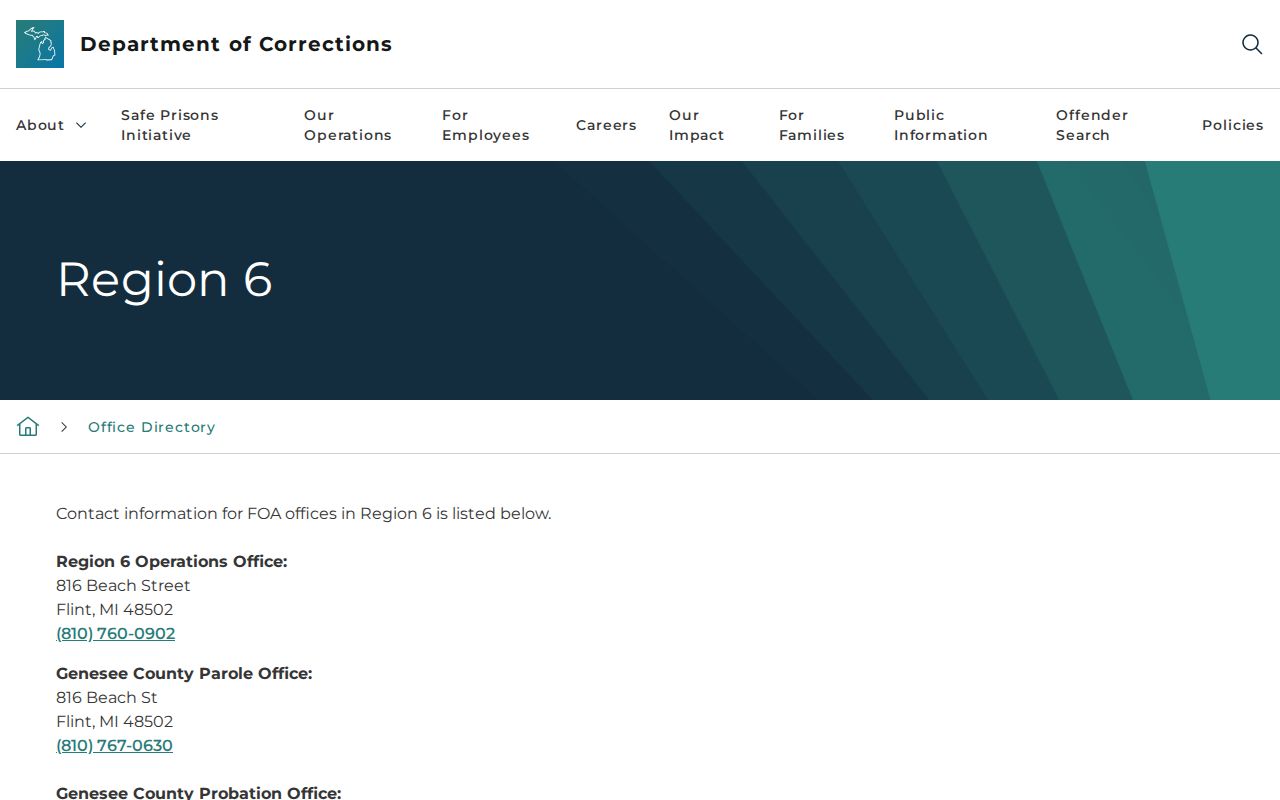
Genesee County is part of MDOC Region 6. The regional operations unit, parole office, and probation office share one building, yet each has its own telephone line and function. The official Region 6 directory should be checked before making contact because state office assignments can change. A person may also be assigned elsewhere. Use the office shown on the live OTIS profile instead of assuming that every Genesee case reports to the same desk.
MDOC Region 6, Genesee Offices
Address:
816 Beach Street
Flint, MI 48502
Region 6 Operations: 810-760-0902
Genesee Parole: 810-767-0630
Genesee Probation: 810-257-3524
The directory contact can clarify public supervision information tied to the record. It cannot change a court judgment. If the issue is probation termination, a later violation order, or a corrected sentence, obtain the signed document from the Genesee court that entered it.
The Region 6 page is shown below as the official source for the separate Genesee contact lines.
Genesee Absconder and Violation Checks
A public “absconder” status should be reported with restraint. It is an MDOC supervision category. It is not proof that a new crime occurred, and it does not by itself prove a current Genesee County Jail booking. OTIS offers separate parole-absconder and probation-absconder filters. A matched result should be checked against the MDOC number and the assigned office before any conclusion is drawn.
Conditions vary by order and person, so broad lists can mislead. At a high level, supervision may require reporting, compliance with court or MDOC instructions, and observance of conditions set in the controlling document. A claimed violation may lead to review, a court action, or custody, but the specific record determines what happened. When a warrant or arrest question matters, use the responsible court or agency rather than translating the OTIS status into a broader claim.
No separate official Genesee County absconder roster was found beyond OTIS status filters. Michigan VINE can send custody-event notices from participating agencies, but it is not a parole-compliance log. The two systems answer different questions.
Genesee Supervision Discharge Records
Three endings must remain separate. A prison release starts parole. A later parole discharge ends MDOC supervision. Probation discharge ends the term ordered by the court. OTIS may show a discharged result during its three-year public window, but that status does not reconstruct every earlier Genesee jail stay. It also does not show the exact physical release time from the county jail.
For parole, request the operative order or discharge certificate from MDOC. For probation, obtain the termination or discharge order from the sentencing court. If only a verbal confirmation is available, note its limits. A signed record is the better source when the exact legal end date matters. MDOC public records can be requested through its FOIA process; a request should identify the person, MDOC number, and document sought.
After OTIS’s public display period ends, use the sentencing court and MDOC records rather than assuming that the supervision never existed. A narrow request can name the parole order, probation record, Basic Information Sheet, or discharge certificate. MDOC limits its PENPACK shortcut to recognized criminal-justice authorities, so an ordinary public request should seek the specific nonexempt record instead of claiming access to that package.
Note: A “Discharged” OTIS result concerns MDOC supervision and does not certify the end of every unrelated local or federal matter.
Genesee Parole Grant Timing
A parole grant is a decision, not the gate event. The MDOC parole process begins before eligibility, uses an interview and structured review, and sends a grant into release processing. MDOC states that at least 28 days separate the Board’s decision from physical release. Release planning and any lawful review still occur in that span.
For that reason, a Board outcome should not be described as completed release. Check the later OTIS status and any Michigan VINE event. When a formal record is required, request the parole order and the later release or supervision document. Public hearing notices cover only a subset of Board matters and do not form a complete calendar of routine Genesee parole decisions.
Genesee Reentry Before Supervision
Genesee County Jail launched the IGNITE education initiative in September 2020. That local history adds context to the period before release and supervision. Published work has examined the program, and more recent reporting describes its growth. Participation, however, does not prove a release date, parole status, probation status, or successful discharge.
The distinction is useful when a program reference appears in a record or news account. Education inside the jail and supervision after custody are separate stages. Verify the legal status through OTIS, MDOC, and the sentencing court rather than drawing a conclusion from program participation. The published evaluation and Michigan Public report provide the sourced local context.